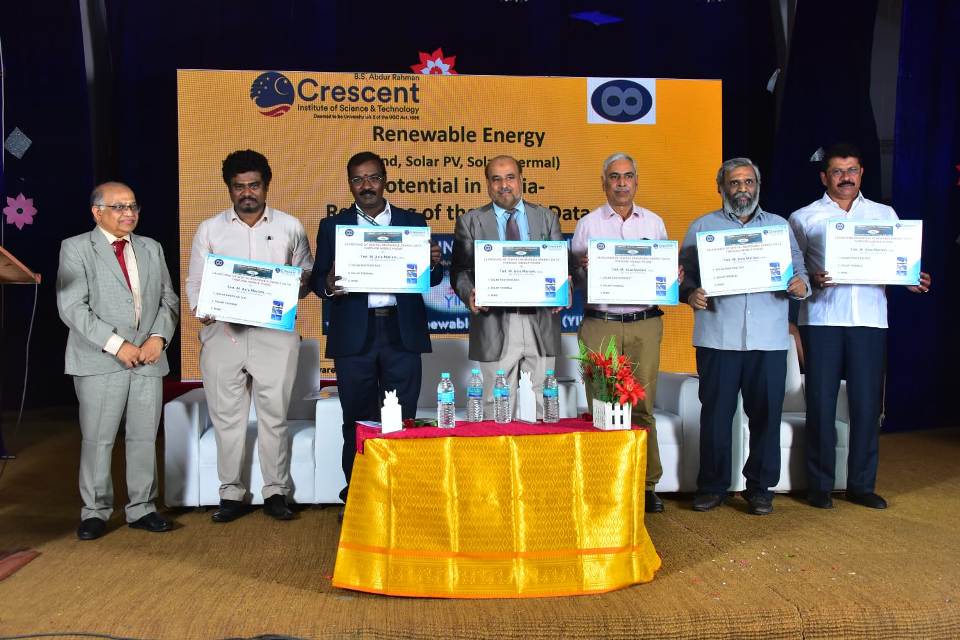

Digital Labs on Thursday focused on three defining pillars for India' energy sovereignty; compute and cloud sovereignty; and services sovereignty.
The partnership focuses on carbon capture, utilisation, and storage, green hydrogen, circular economy solutions and industrial-scale technology deployment.
This expansion, driven by various schemes and diverse installations, highlights the state's commitment to clean energy. The growth is fostering local employment and reducing carbon emissions, paving the way for a sustainable energy future.
These initiatives will benefit over 8,900 farmers across 61 canal outlets in four districts, aiming to enhance sustainable agriculture and water management.
The project entails supplying hybrid power with a minimum annual Capacity Utilisation Factor (CUF) of 50 per cent and meeting 80 per cent of daily peak power requirements.
The company, formerly a joint venture, is currently undergoing insolvency proceedings. INOXGFL's bid is structured through two separate entities, targeting different aspects of Wind World India's assets. This move signals a major development in the renewable energy sector.
This achievement, marked by a final blast initiated by NHPC Director (Projects) Sanjay Kumar Singh, is vital for advancing construction and ensuring smooth river diversion.
NITI Aayog Vice Chairman Suman Bery outlined a vision that connects economic growth, women's workforce participation, and India's push for energy self-sufficiency, arguing that clean technology and competitive infrastructure can reinforce the country's development trajectory.
The International Solar Alliance (ISA) unveiled a global mission to assist more than 120 member countries in fast-tracking artificial intelligence-enabled clean energy during the India AI Impact Summit 2026.
The nation offers practical solutions to global challenges. India maintains high growth with low inflation. Digital Public Infrastructure ensures efficient welfare delivery. India is the fastest-growing major economy with sustainability at its core.
This milestone supports India's ambitious renewable energy and net-zero emission targets. The launch of the India-UK Offshore Wind Taskforce aims to accelerate the development of offshore wind energy, a crucial component for India's energy transition.
Frames to support module manufacturing at Florida facility from mid-2026; deal scalable to 3 GW.
The company offers shares at ₹1,000-1,053 each. This public offering includes a fresh issue and an offer-for-sale. Proceeds will be used for debt repayment and general corporate needs.
Both leaders agreed to utilize the Trade and Economic Partnership Agreement for growth in blue and green economies.
Residents are increasingly adopting solar power, showing a growing acceptance of this clean energy source. The success highlights community engagement in driving green transitions.
The acquisition gives TIL access to manufacturing of LNG and hydrogen powerpacks for its material-handling equipment, along with capability in cryogenic LNG storage tanks, oil and gas process vessels and skids.
An activist investor is pushing for a spin-off of the wind division. Management aims for the unit to break even this year. Shareholders believe the company's strong share price offers a buffer. The future of the wind division will be debated soon.
NTPC, Tatyasaheb Kore, and MAHAGENCO will execute these power generation projects using water from high-altitude reservoirs. Specific water volumes have been reserved for projects in Raigad, Kolhapur, and Ahilyanagar districts.
India's solar manufacturing sector faces a "structural glut" after a 13-fold capacity increase since 2020, now exceeding domestic demand. This surge has led to reduced capacity utilisation at module-assembly plants, prompting banks to advise caution and manufacturers to scale back lower-value output.
While NHPC operates the project, no direct expenditure on local area development has been met from this revenue. Instead, 13% free power, including the LADF, is utilised by Jammu and Kashmir to cover power purchase costs and ensure reasonable electricity rates for consumers.